



 Verified by shop




What to Remove First When Your Skin Freaks Out

Your skin is red, hot, stinging, breaking out in places it usually does not, or peeling in patches. The first instinct is to reach for another product to fix it. That instinct is usually wrong. When skin is in active crisis, the answer is rarely addition. It is almost always strategic subtraction. This article walks through the exact order to pull products out of a routine when skin freaks out, what to keep on the bare-minimum list, and how to reintroduce actives later without relapsing.
This article is part of our Sensitive Skin pillar cluster. For the foundational framework on reactive skin, its triggers, and how to restore balance, see our complete guide to sensitive skin causes, triggers and how to restore balance.
First, decide what you are actually looking at
Not every skin flare is the same problem, and the wrong intervention can make a benign adjustment worse or let a real allergy escalate. Before you remove anything, take thirty seconds to sort the symptoms into one of three buckets.
- Active-ingredient adjustment (sometimes called "purging") - small breakouts in your usual acne-prone areas, mild dryness, light peeling. Onset within the first 2 to 6 weeks of a new active. No burning, no rash outside the usual zones.
- Irritation or sensitised skin - diffuse redness, stinging when product is applied, hot or tight feeling, light flaking. Often linked to over-exfoliation, overlapping actives, or a barrier that has been pushed too far. Settles when you stop the offending product.
- Contact dermatitis or allergy - intense itching, swelling, blisters, oozing, a rash that appears in unusual areas (around the eyes, the neck, behind the ears), or a reaction that escalates rather than improves. Needs medical attention, not another moisturiser.
The first bucket can usually be ridden out with a gentler routine. The second is the focus of this article. The third needs a dermatologist and possibly patch testing. Our deeper read on sensitive, sensitised and barrier-damaged skin explains why these three states look similar but need different responses.
The remove-first hierarchy
When the diagnosis is "my skin is reacting and I do not know exactly to what," the safest move is to pull products out in a specific order. The most irritating, most recently added, or most concentrated products come out first. The barrier-supportive minimum stays.
Step 1 - All leave-on actives
This is the non-negotiable first cut. Pause every active treatment, whether you suspect it or not, for 7 to 14 days. That includes:
- Retinoids - retinol, retinaldehyde, prescription tretinoin, encapsulated retinol
- Chemical exfoliants - AHA (glycolic, lactic, mandelic), BHA (salicylic), PHA, peel pads
- High-concentration vitamin C - especially L-ascorbic acid at 10 percent or more
- Benzoyl peroxide, azelaic acid at treatment strength, sulfur masks
- Niacinamide above 5 percent if it was recently introduced
Yes, all of them at once. People resist this because they fear losing months of progress. The opposite is true: pushing through a flare with the actives still in the routine almost always makes the flare longer. A short, decisive pause shortens total recovery. For the reasoning on why combining retinol and acids multiplies irritation, see our piece on combining retinol and exfoliating acids.
Step 2 - Physical exfoliation in any form
Mechanical aggression is the second most common driver of a flare and is usually invisible because it does not look like a skincare product. Pause:
- Granular scrubs and exfoliating beads
- Cleansing brushes (sonic or rotating)
- Washcloth scrubbing, even soft ones
- Microfibre towels rubbed across the face
- Konjac sponges and similar textured pads
For 2 weeks minimum, wash with hands only and pat dry with a clean cotton towel. The mechanical pause does more work than most people realise. Our piece on how often to exfoliate covers the cumulative damage angle.
Step 3 - Fragranced products and essential oils
Fragrance is one of the most common contact-dermatitis triggers, and essential oils are not the kinder alternative most people assume. Pause:
- Fragranced toners and mists
- Anything containing essential oils (lavender, tea tree, rosemary, citrus oils)
- Heavily perfumed cleansers
- Body products applied near the face (perfumed shampoo, scented neck lotion)
The INCI list will tell you. "Parfum" or "fragrance" near the end is still a meaningful exposure on inflamed skin. Our piece on essential oils on the face covers why "natural fragrance" is not automatically safer.
Step 4 - Foaming and sulfate-heavy cleansers
If your cleanser produces a satisfying lather and leaves your skin feeling squeaky clean, it is almost certainly stripping the barrier further. Swap it temporarily for:
- A cream cleanser, milk cleanser, or oil cleanser
- Lukewarm water only at night if even gentle cleansers sting
- Once-daily cleansing (evening) instead of twice during the flare
The classic over-cleansed barrier feels tight, looks dehydrated, then produces more oil within hours, which drives more aggressive cleansing. See why dehydrated skin can feel oily for the loop.
Step 5 - The most recently introduced product (even the "safe" ones)
If the flare started within 2 weeks of adding something new, that product is the prime suspect, regardless of how innocuous it looks. Pause it and reintroduce after the flare settles, on a small patch first. This applies even to products marketed "for sensitive skin." That labelling is not regulated, and a formula your friend tolerated may still trigger you. Our read on why sensitive skin is a state and not a fixed type explains the variability.
Step 6 - Treatment masks, peels, and at-home devices
Anything intended to "treat" or "boost" the skin gets paused entirely:
- Clay masks, charcoal masks, peeling masks
- Sheet masks with actives (vitamin C sheets, glycolic sheets)
- At-home microneedling, dermarollers, dermaplaning
- LED masks at high settings (low-setting red light is usually fine, but skip if in doubt)
- Steam treatments
None of these belong on reacting skin. The routine you are pruning down to should feel almost boring. That is the point.
What to keep - the 3-product flare routine
Once the cuts are made, the routine should collapse to three products, applied twice a day with zero variation:
- Gentle cleanser - cream, milk, or non-foaming gel. No fragrance, no sulfates, no acids in the formula. Used once at night, water-only in the morning if cleansing stings.
- Ceramide-rich, barrier-supportive moisturiser - look for ceramides, cholesterol, fatty acids, panthenol, glycerin, hyaluronic acid. Skip anything fragranced. Apply on damp skin to lock in hydration.
- Mineral SPF - if you go outside or sit near windows, a zinc-oxide-based broad-spectrum SPF 30 or higher. Mineral filters are usually better tolerated by inflamed skin than older chemical filters.
Sunscreen during a flare is non-optional. A compromised barrier is more vulnerable to UV damage, and any recently used active (retinoids especially) leaves the skin more photosensitive for weeks. See our guide to SPF for sensitive skin and the deeper science in next-generation UV filters.
That is the entire routine for the duration of the flare. No serum, no treatment, no "this one's calming so it should be fine." The rule when skin is in crisis is fewer variables, not more "calming" ingredients. See what dermatologists mean by "fix the barrier first" for the underlying logic.
How long the reset takes
For most people with an irritation flare (not a true allergy), the worst symptoms settle within 5 to 7 days of cutting back to the 3-product routine. Visible redness fades over 10 to 14 days. The barrier itself, measured by transepidermal water loss in laboratory studies, can take 4 to 6 weeks to fully restore lipid balance. Even when your skin looks calm by day 10, you are not yet at the point of safely reintroducing the strongest actives. The visible recovery runs ahead of the structural recovery, and pushing actives back in too early is one of the most common reasons people relapse into a second flare within the same month.
Reintroducing actives - one at a time, at half strength
Once the skin has felt comfortable for at least 7 consecutive days (no burning, no redness, no peeling, no stinging on application), the careful rebuild begins. The rules are non-negotiable.
- One active at a time - never two on the same week. If you reintroduce vitamin C and retinol together and the skin reacts, you cannot tell which one caused it.
- Half the previous frequency - if you were using retinol nightly before the flare, restart at twice a week. If you were doing acids 3 times a week, restart at once a week.
- Buffer with moisturiser - apply moisturiser before the active or sandwich the active between two thin moisturiser layers. This is the so-called "sandwich method" and it genuinely improves tolerance.
- Observe for 1 full week - before adding anything else. If the week is clean, double the frequency. If anything stings or flares, drop back and wait another week.
- Start with retinol last, not first - reintroduce the least irritating active first (often niacinamide or a stable vitamin C derivative). Retinoids go in last because they are usually the most reactive variable.
The total reintroduction window from "barrier calm" to "full previous routine" is typically 6 to 8 weeks. That feels slow. It is faster than another month-long flare. For a fuller protocol on stacking actives without triggering this cycle, see smart ingredient stacking and our gentle retinol routine for sensitive skin.
When to see a dermatologist
Most irritation flares settle within 2 weeks on the protocol above. Some do not, and some are not actually irritation in the first place. Book a dermatology appointment if you see any of the following:
- Symptoms still active 14 days after pulling all suspect products
- Blisters, oozing, weeping patches, or honey-coloured crusts (possible infection)
- Rash spreading to the neck, eyelids, or behind the ears
- Painful swelling, especially around the eyes or lips
- Recurrent flares every few weeks despite a stable routine
- Skin that burns even with water or unfragranced moisturiser
- Fever or systemic symptoms alongside the skin reaction
Patch testing through a dermatologist can identify specific contact allergens (preservatives, fragrance components, lanolin, certain UV filters) that trial and error cannot. If you have an autoimmune condition or take medications that affect skin, the threshold to seek medical advice is lower.
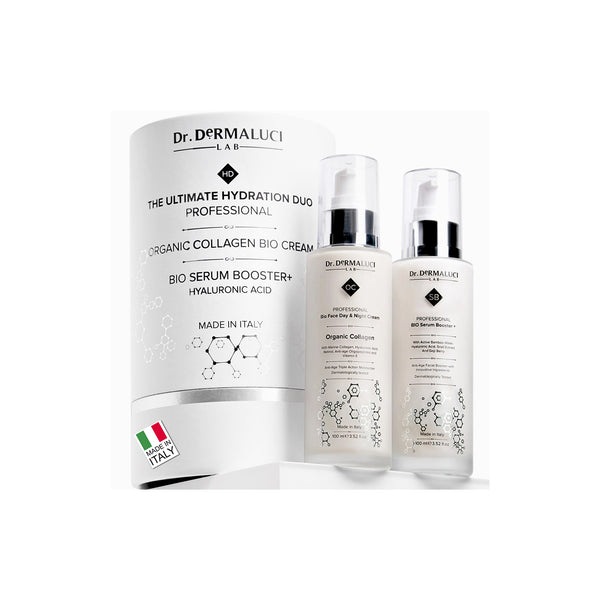
The Dr. Dermaluci Lab philosophy on reactive skin
Our founder Valeria lives with Graves' disease and Hashimoto's thyroiditis. Both shaped how the brand approaches barrier-disrupted, reactive, autoimmune skin. Formulation choices are intentionally low concentration, and actives are paired with calming, barrier-supportive co-ingredients rather than stacked at maximum strength. If your skin is currently freaking out, the answer is not the next bottle. It is the deliberate removal of the variables working against it, patient defence of the barrier with a minimum routine, and a slow, observant reintroduction.
Quick action checklist
- ✓ Pause every leave-on active (retinoids, acids, high-strength vitamin C, benzoyl peroxide) for 7 to 14 days
- ✓ Stop all physical exfoliation - scrubs, brushes, washcloth use, cleansing devices
- ✓ Remove fragranced products and essential oils from face and surrounding body care
- ✓ Switch foaming or sulfate-heavy cleanser to cream, milk, or oil; cleanse once at night only
- ✓ Identify and pause the most recently added product if onset was within the past 2 weeks
- ✓ Hold to a 3-product routine - gentle cleanser, ceramide-rich moisturiser, mineral SPF
- ✓ Wait 7 full days of calm skin before reintroducing the first active, at half previous frequency
- ✓ Reintroduce one active per week, retinoids last, and observe before stacking again
- ✓ See a dermatologist if symptoms persist past 14 days, spread, or show signs of infection
Frequently asked questions
How do I tell purging from irritation when both can look like breakouts?
Purging happens in your usual acne-prone zones and shows up as small whiteheads or surfacing closed comedones within 2 to 6 weeks of a new active. Irritation tends to add diffuse redness, stinging on application, tightness, or rash in areas you do not normally break out. If burning or sting is present, treat it as irritation until proven otherwise.
Can I keep using niacinamide or hyaluronic acid during a flare?
Only if you have been using them for months without issue and the formula is simple and unfragranced. The rule during a flare is fewer variables, not more "calming" ingredients. If you are uncertain whether a product is contributing to the reaction, leave it out. You can always reintroduce a tolerated product later, but you cannot undo a flare extension by adding something during the storm.
How long should I wait before restarting retinol?
Wait until your skin has felt completely comfortable for at least 7 consecutive days, then restart at half your previous frequency. If you were on nightly retinol, that means twice a week. Buffer with moisturiser before and after, and stay at the reduced frequency for at least 2 weeks before stepping up. Retinoids should be the last active reintroduced, not the first.
Is a mineral sunscreen actually better for reactive skin, or is that a marketing claim?
Both modern mineral filters and next-generation organic filters (Bemotrizinol, Ethylhexyl Triazone) are well tolerated by most sensitive skin. The reason to default to mineral during an active flare is that zinc oxide has a very low irritation profile and is the most predictable option when the barrier is compromised. Once skin is calm, well-formulated next-generation organic SPFs are usually fine too.
Can I patch test a new product while my skin is still flaring?
No. Patch testing on inflamed skin is unreliable because almost anything will sting on damaged skin. Wait until the barrier feels comfortable, then patch on the inner forearm or behind the ear for 5 to 7 days before applying to the face. If trial and error is not narrowing the trigger down, dermatology patch testing under controlled conditions is the precise answer.
Should I stop my SPF if I think it might be irritating me?
Try a different SPF rather than going without. A compromised barrier is more vulnerable to UV damage, and skipping sun protection during a flare can extend the recovery period through cumulative photo-damage. Switch to an unfragranced zinc-oxide-based mineral SPF and see if symptoms settle. Going without sunscreen entirely is rarely the right answer, especially if you were recently using retinoids.
Why does my skin react to almost everything now when I used to tolerate everything?
Skin tolerance is not fixed. Hormonal shifts, stress, age, gut health, climate, and accumulated barrier damage from previous over-use of actives can all narrow the window of what your skin tolerates. The piece on how hormonal shifts change product tolerance over time covers the mechanism in detail. Reactive skin is often the result of years of small assaults, not a sudden change in identity.
Related articles


