



 Verified by shop




What AIAB Certification Means for Your Skincare

The word "organic" on a skincare label means almost nothing on its own. Cosmetics regulations in the EU do not define what organic skincare is, and any brand can put the word on packaging without legal challenge. What gives the word weight is the certification body behind it — a third-party organisation that audits the brand's ingredient sourcing, formulation, and supply chain against a documented standard.
This article is part of our Holistic Skin Health pillar cluster. For the foundational framework, see our complete guide to holistic skin health.
Our skincare line is certified by AIAB. This article explains what AIAB is, what it audits, what its certification mark actually guarantees, and why we chose this body rather than a more globally recognised one. It also explains, honestly, the limits of what any organic certification can promise.
What AIAB Is
AIAB stands for Associazione Italiana per l'Agricoltura Biologica — the Italian Association for Organic Agriculture. It is one of the longest-standing organic certification bodies in Italy, established in 1988 and accredited under EU organic agriculture regulations.
AIAB originally certified organic food and farming. Over the last fifteen years it has extended its standard to cover cosmetics, with a specific Bio Eco Cosmesi standard that audits formulations against:
- Minimum percentage of certified-organic plant ingredients in the formula
- Exclusion of specific synthetic ingredients (parabens, silicones, PEGs, phthalates, sulphates, mineral oil, GMO-derived materials)
- Restricted preservative system (only short-list preservatives accepted)
- Packaging environmental impact
- Manufacturing process documentation and traceability
The certification is product-specific, not brand-wide. Each formula is audited and certified individually. A brand can carry AIAB-certified products alongside non-certified ones — which matters for our positioning, because our newer Liquid Contour Essentials makeup line is not currently AIAB-certified while our skincare line is.
What AIAB Certification Actually Guarantees
1. Ingredient Sourcing Documentation
Every plant-derived ingredient in an AIAB-certified product must come with documentation tracing it back to a certified-organic source farm. This is the heart of organic certification: not the absence of synthetics, but the verifiable presence of organic-grown raw materials.
2. Synthetic Exclusion List
AIAB maintains a specific exclusion list of synthetic ingredients that cannot appear in a certified product. This includes the well-known concerns (parabens, formaldehyde releasers, sodium lauryl sulphate) but also less-discussed ingredients like petroleum-derived emollients (paraffinum liquidum, mineral oil) and certain synthetic colourants.
3. Preservation System Constraints
Modern cosmetic preservation is necessary — water-based formulas grow bacteria within days without it. AIAB does not allow preservative-free formulas (which would be unsafe), but restricts the preservatives that can be used to a defined shortlist of food-grade and naturally-derived options like phenoxyethanol below specific concentrations, sodium benzoate, potassium sorbate and dehydroacetic acid blends.
4. Manufacturing Audit
The certification covers manufacturing process, not just the formula. AIAB auditors check the production facility for cross-contamination risk, cleaning protocols, raw material storage, and batch documentation. Without manufacturing audit, the formula on paper would not prove anything about the product in the bottle.
5. Annual Re-certification
Certification is not permanent. Every certified formula must be re-audited annually, and any reformulation triggers a fresh audit. This prevents the common pattern of a brand certifying once, then quietly reformulating without recertification.
What AIAB Does Not Guarantee
It is important to be honest about the limits:
- ✓ AIAB does not certify a product as "100% natural" — the standard allows specific synthetic ingredients where natural alternatives are unsafe, unstable or unavailable
- ✓ AIAB does not certify a product as vegan — that is a separate certification with separate criteria
- ✓ AIAB does not certify clinical efficacy — an organic-certified formula is not automatically more effective than a non-certified one
- ✓ AIAB does not certify a product as fragrance-free or preservative-free — both are allowed at restricted levels
- ✓ AIAB does not regulate marketing claims — a brand can carry the mark and still make claims outside the certification scope
Why We Chose AIAB Rather Than ECOCERT or COSMOS
ECOCERT and COSMOS are more internationally recognised certification bodies. AIAB is more focused on Italian production. Three reasons we chose it:
1. Italian Production Alignment
Our skincare is produced in our partner Italian lab. AIAB's auditors are based in Italy, familiar with Italian supply chains, and operate in the same regulatory framework as our manufacturer. The audit process is more rigorous when the auditor speaks the same regulatory language as the producer.
2. Stricter Preservation List
AIAB's accepted preservative shortlist is more restrictive than ECOCERT's. For formulations targeting sensitive and reactive skin, this matters because preservation is one of the most common triggers of cosmetic reactivity. A tighter preservative list means less reaction risk.
3. Annual Re-audit Cadence
The annual re-certification cycle means a formula cannot drift over time without being re-checked. Some certification bodies operate on three-year cycles, which gives more room for unaudited changes between audits.
Which Dr. Dermaluci Lab Products Are AIAB-Certified
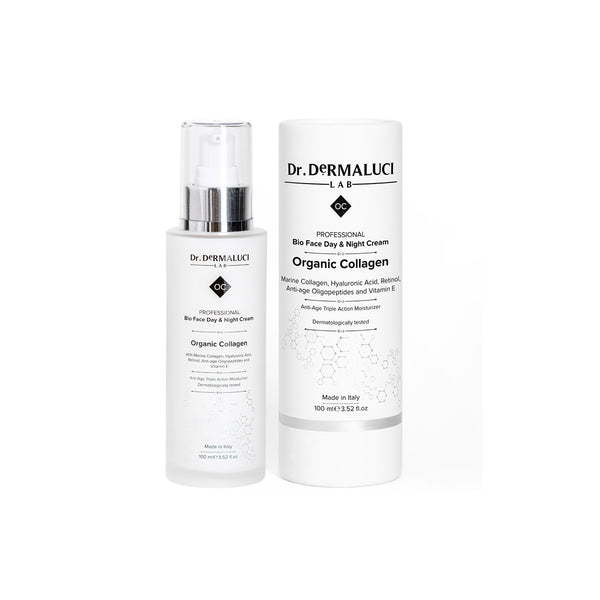
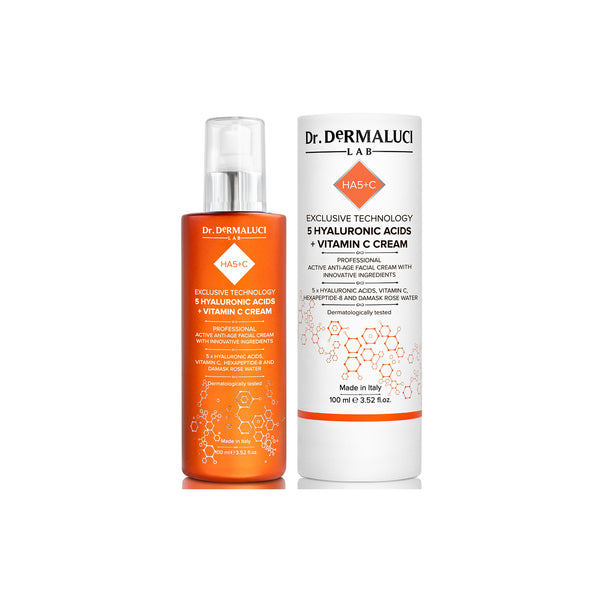
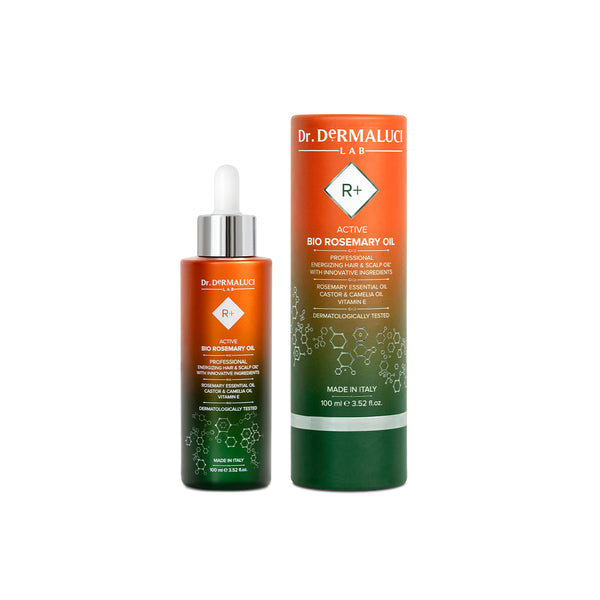
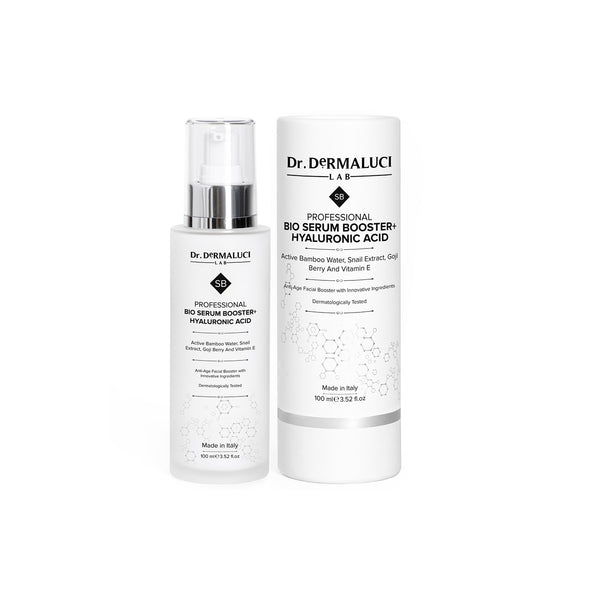
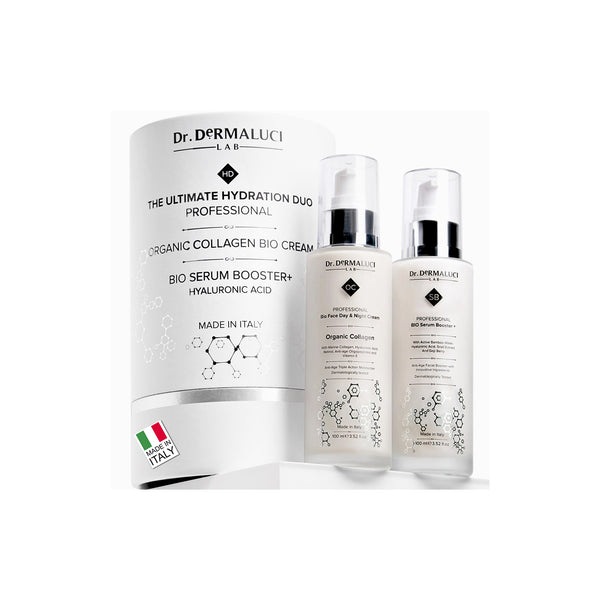
The full skincare line carries the AIAB Bio Eco Cosmesi mark:
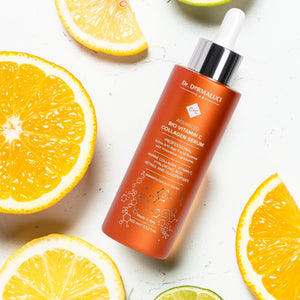
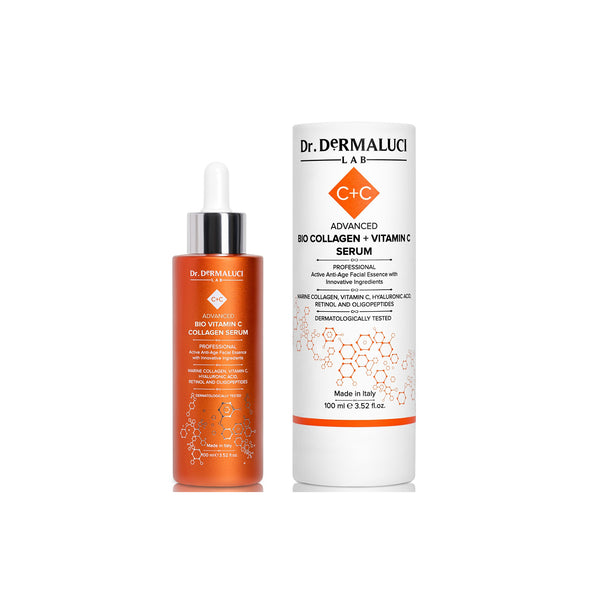
- ✓ Vitamin C + Collagen Serum
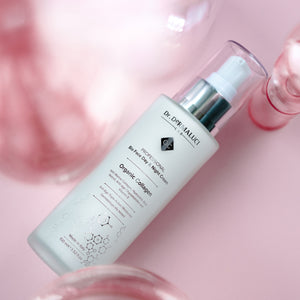
- ✓ Marine Collagen Face Cream
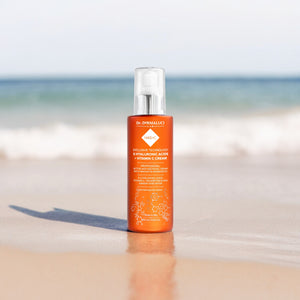
- ✓ 5x Hyaluronic Acid + Vit C Cream
- ✓ Bio Booster HA Serum
- ✓ Boom Lash Serum
- ✓ Slimming Pant Pro
- ✓ Rosemary + Castor Oil
The Liquid Contour Essentials makeup line, launched April 2026, is not currently AIAB-certified. We use the same clean formulation philosophy and the same Italian lab, but cosmetic colour formulations have a different certification pathway that we are still working through.
How to Verify AIAB Certification
The AIAB mark on a product label is not enough on its own. To verify a product is genuinely certified:
- Look for the AIAB certification number printed on or near the mark
- Cross-check the number on AIAB's online certified-product database (free, public access at aiab.it)
- Verify the brand and product name match the database entry
- Check the certification date is current (within the last twelve months)
This applies to any organic certification mark on any product. Counterfeit certification marks exist and the only way to verify is the official database.
Quick Reference: How to Verify Any Organic Skincare Claim
- ✓ Look for a named certification body (AIAB, ECOCERT, COSMOS) — not just the word "organic" or "natural"
- ✓ Find the certification number printed on or near the mark
- ✓ Cross-check the number on the certifying body's public online database
- ✓ Verify the certification date is current (within the last twelve months)
- ✓ Check if certification is product-specific or brand-wide (most are product-specific)
- ✓ Look at separate claims (vegan, cruelty-free, gluten-free) — each needs its own certification
- ✓ Read the full ingredient exclusion list, not just the certification mark
Frequently Asked Questions
What does AIAB certified mean?
It means a third-party Italian organic certification body has audited the product's ingredient sourcing, formula composition, preservation system, manufacturing process, and annual re-certification status against the AIAB Bio Eco Cosmesi standard. The product cannot contain specific excluded synthetics and must source plant ingredients from certified organic farms.
Is AIAB more strict than ECOCERT or COSMOS?
On preservation system, yes — AIAB's accepted preservative shortlist is shorter than ECOCERT's. On overall organic content threshold, the standards are broadly comparable. On manufacturing audit, AIAB is similar to ECOCERT and stricter than COSMOS basic certification.
Are all Dr. Dermaluci Lab products AIAB-certified?
The skincare line is AIAB-certified. The Liquid Contour Essentials makeup line is not currently certified. Each product page indicates certification status clearly.
Does AIAB certification mean a product is vegan?
No. AIAB certifies organic agricultural sourcing and formulation, not animal-product exclusion. A vegan claim requires separate certification. We do not currently claim vegan on any product because we do not carry vegan certification.
Is AIAB certification recognised outside Italy?
Yes, throughout the EU and increasingly in international markets. AIAB is accredited under EU Regulation 834/2007 on organic production. The certification mark is legally valid for sale in all EU member states.
Why isn't every organic-claiming brand AIAB-certified?
Because certification is expensive, time-consuming, restricts formulation freedom, and requires annual re-audit. Brands that put "organic" or "natural" on a label without certification do so because the word is unregulated. The certification mark is the difference between marketing claim and audited fact.
How often is certification renewed?
Annually. Every certified formula must pass a fresh audit each year, and any reformulation triggers a separate audit cycle before the certification mark can continue to appear on the new version.
→ Want to understand how this fits the broader clean beauty conversation? Read Is Dr. Dermaluci Lab a Clean Beauty Brand?
→ Want to learn how to read what's actually in your skincare? Read How to Read a Skincare Label: INCI, Actives, and Marketing Myths.
Read more


