



 Verified by shop




Rosemary + Castor Oil for Hair Care: The Science of Stronger Hair and Scalp Health

Rosemary oil and castor oil are two of the most-studied botanical oils for hair and scalp care, and one of the few combinations where the evidence is more than folk wisdom. In this article we look at what the research actually shows, why the combination works better than either ingredient alone, and how to apply it for visible results without overpromising what botanical oils can do.
This piece is part of our hair care series and connects to our deeper work on sensitive skin, because scalp health and skin health follow the same underlying principles.
The science of rosemary oil for hair growth
Rosemary oil is not a wellness fad. The most-cited study comes from Skinmed (2015), a peer-reviewed clinical trial that compared rosemary oil to minoxidil 2% over six months in patients with androgenetic alopecia. The result: both groups showed comparable hair count improvement at six months, with the rosemary group reporting fewer scalp side effects, notably less itching.
What rosemary appears to do:
- Stimulates microcirculation in the scalp, improving oxygen and nutrient delivery to the hair follicle
- Has mild anti-inflammatory action, reducing the chronic low-grade scalp inflammation that contributes to follicle miniaturisation — see our work on skin inflammation science
- Contains carnosic acid, an antioxidant that helps protect follicles from oxidative stress
The mechanism is not magical, it is vascular and anti-inflammatory. That is why results take weeks, not days. Rosemary does not create new follicles, it supports the health of the follicles you already have.
Castor oil: the heavyweight companion
Castor oil works on a different axis. Its main active is ricinoleic acid, a fatty acid that:
- Coats the hair shaft, reducing mechanical breakage during brushing and washing
- Has emollient action, sealing in moisture along the cuticle — the same principle behind barrier-supporting actives in facial skincare
- Supports scalp barrier function in dry or flaky scalp conditions
Cold-pressed castor oil retains more of the active fatty acid content than heat-processed alternatives. When choosing castor oil, look for the words cold-pressed and organic on the label.
A note on the claim that castor oil "grows" hair: there is less direct clinical evidence here than for rosemary. The most realistic framing is that castor oil protects and supports existing hair, while rosemary actively stimulates the follicle environment. They complement each other, they do not do the same job.
Why the combination outperforms either alone
A pure rosemary essential oil is potent but can be too concentrated for direct scalp application. It needs to be diluted in a carrier oil. Castor oil is a natural carrier: thick enough to dilute the essential oil safely, nourishing enough to deliver its own benefits in parallel.
The combination addresses the three layers of hair health simultaneously:
- Follicle stimulation (rosemary's microcirculation effect)
- Strand protection (castor oil's emollient and shaft-coating action)
- Scalp barrier support (both contribute, in different ways)
This is why a properly formulated rosemary and castor oil treatment outperforms either oil used alone, and why the order of ingredients on the label matters. A formula that lists castor oil first will deliver the dilution and protection benefits; one that lists rosemary first risks being too concentrated for sensitive scalps.
How the right oils restore scalp health
A healthy scalp is the foundation of healthy hair. Scalp problems — flakiness, tightness, sensitivity, oiliness — are skin problems, and they respond to the same principles we apply to facial skincare routines:
- Do not strip the barrier with harsh shampoos
- Do not over-treat (more is not better)
- Match the active to the actual need
For most people, the right routine is 2 to 3 oil treatments per week, applied to the scalp first and worked through the lengths. The body's natural sebum production rebalances when the scalp is not being constantly stripped, and the visible result is hair that feels softer, less prone to breakage, and over weeks thicker at the root. The same logic applies to why progress can stall when we over-treat instead of giving the system time to respond.
Application: the method that maximises results
The application matters as much as the formula. Here is the routine that gets results:
- Start dry. Apply the oil to a dry scalp, not damp, not wet. Wet hair already has water saturating the follicle and the oil sits on top.
- Drop onto the scalp, not the hair. Use a pipette or dropper. The hair length does not need the oil as much as the scalp does.
- Massage for 3 minutes. This is where most people cut corners. The massage is part of the active treatment, it mechanically encourages blood flow.
- Leave it for at least 2 hours, ideally overnight. Wrap a cotton t-shirt around the pillow if you are worried about staining.
- Wash out with a mild shampoo. One wash is usually enough if the oil was applied to the scalp only.
- Repeat 2 to 3 times per week. Daily is unnecessary and can over-load the scalp.
Common myths and misconceptions
"Rosemary oil grows hair as fast as minoxidil."
The 2015 study showed comparable results at six months, but minoxidil typically shows results faster in clinical settings. Rosemary is a gentler approach, better tolerated, and a real option for people who cannot use minoxidil due to side effects.
"More oil means faster results."
False. Over-applying creates buildup that can clog follicles and dull hair. Less is more — the same principle covered in our myth-busting series.
"If it does not work in two weeks, it does not work."
Hair grows about 1.25 cm per month. Any visible improvement in shedding, breakage or thickness needs 8 to 12 weeks minimum to assess fairly.
"Castor oil is always better than other carrier oils."
For dry, coarse or curly hair, often yes. For very fine or flat hair, castor oil can feel too heavy. In that case a lighter carrier (jojoba, argan) may work better, with rosemary added separately.
Choosing a quality rosemary and castor oil
Most rosemary and castor oils on the market are diluted with cheap filler oils and do not contain enough of either active to do meaningful work. Here is what to look for on a label:
- Cold-pressed castor oil as a primary ingredient (not refined)
- Rosemary leaf oil or extract named explicitly (not "fragrance")
- A short ingredient list — fillers dilute the actives. See our guide on how to read a skincare label for more
- Bottled in dark glass with a pipette (light degrades the oils; a pipette controls dose)
- Certified organic where possible (botanical actives accumulate pesticides if not)
- Made in a single, traceable lab (avoid white-label rebrands)
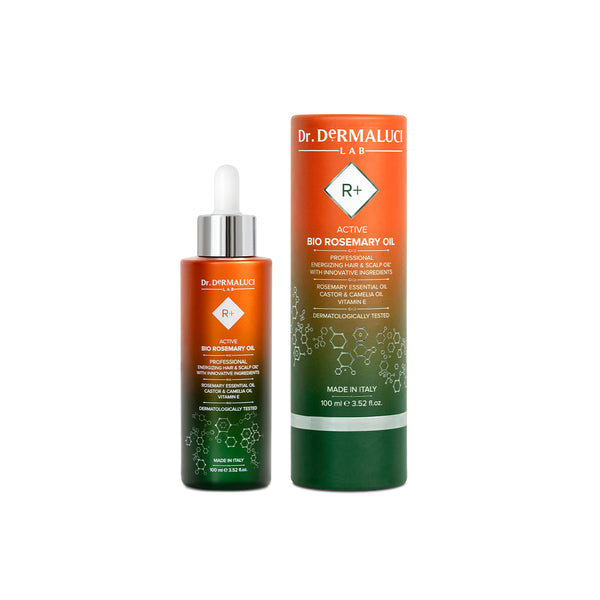
Our own Rosemary and Castor Oil is formulated to this brief: cold-pressed castor oil base, rosemary leaf oil at therapeutic dose, supporting actives (macadamia, camelina, vitamin E and C), made in our Italian lab, packed in recyclable glass with a pipette. Not because we are the only good option, but because if you are going to do this routine, the inputs matter.
Frequently asked questions
Does rosemary oil really grow hair, or is it marketing?
The 2015 Skinmed clinical trial showed measurable hair count improvement in patients with androgenetic alopecia after six months of daily rosemary oil application, comparable to minoxidil 2%, with fewer reported side effects. So the short answer is: there is real evidence, but the effect is gradual, not dramatic. Do not expect overnight results.
How long until I see visible results?
First signs (less shedding, healthier-looking scalp): typically 4 to 6 weeks at 2 to 3 applications per week. Visible hair density improvement: 12 to 24 weeks. Anyone promising faster is overselling.
Can rosemary oil replace minoxidil?
For mild-to-moderate cases and for people who tolerate minoxidil poorly, rosemary oil is a credible alternative supported by clinical evidence. For more advanced hair loss, talk to a dermatologist, a combination approach is often more effective than either alone.
Is castor oil too heavy for fine hair?
It can be. If your hair feels weighed down after one application, try diluting the castor oil with jojoba or argan (50/50), and apply only to the scalp and roots, not the lengths.
Should I leave the oil on overnight?
Overnight is ideal because it maximises absorption time, but a minimum of 2 hours is enough to see benefits. If you do not have time for overnight, do 2-hour sessions twice a week rather than rushing 30-minute applications.
How often should I use rosemary and castor oil?
2 to 3 times per week is the sweet spot. Daily applications do not accelerate results and can build up on the scalp. Less is more.
Can I use it on dyed or chemically treated hair?
Yes, and in fact, chemically treated hair often benefits more, because the oils help repair the cuticle damage from colour and chemical processes. Always patch-test first if your scalp is sensitive post-treatment.
Is it safe to use during pregnancy or while breastfeeding?
Topical rosemary in small amounts is generally considered safe, but we recommend checking with your doctor before adding any new topical product during pregnancy or breastfeeding. The clinical evidence is on healthy adults outside these contexts.
Related articles


